2 September 2020 by Mondo2.0
Advertising & Internet: an indissoluble marriage
When we began telling you about the evolution of the Internet, back in the “distant” 2013, we used statistics to better explain the spread of social networks. Now we no longer need numbers to convince you that Google is used by everyone, that all very young people are on TikTok, that everyone shares holiday photographs through Instagram or WhatsApp, that everyone obsessively reposts memes on Facebook.
The term “everyone” today is almost one with the word “Internet”.
But the Internet, a (virtual) universe in constant motion, continuously sets itself new goals and has new social and usage dynamics. And to explain something new, as in the “old days”, we use some statistics. In particular, we refer to the “Focus on Online Advertising”, special edition of the AGCOM Communications Observatory (available at this address).
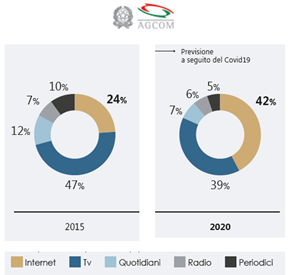
For the first time, revenues generated by online advertising have exceeded those of the other media (Television, Newspapers, Radio, Periodicals).
The data provided by AGCOM show a growing trend:
- In 2015 online advertising accounted for 24%, growing compared with the past but still far from TV’s 47%.
- In 2020 online advertising accounted for 42%, with TV at 39%, with a sharp reduction in the share devoted to newspapers and periodicals. So “the Net beats paper”, at least from the point of view of advertising revenues, and also overtakes TV.
Data worth reflecting on, and in the rest of this article that is exactly what we will try to do.
- Periodicals and newspapers have particularly negative indicators.
We have often discussed this in this blog: digital reading is gaining ground. The very frequent use of the smartphone “to read” the latest news, real-time news, has become a habit, a ritual to be repeated several times a day. Fast reading in chats and on social networks pushes us to get informed “in real time” and, at the same time, to explore less deeply.
Online “dynamic reading”, superficial and hypertextual, has significantly reduced interest in printed publications. Less interest, fewer sales, lower advertising revenues. - TV no longer holds a monocentric, dominant position, maintained for more than fifty years. Now, in the “media system”, there are in fact only two, and one of them, the Internet, is slowly incorporating the other.
This greatly reduces TV’s political and social power of persuasion.
TV has less ability to attract revenues and also less ability to influence the masses than in the past. It has a greater impact on users who have a digital divide with respect to the Internet, a market segment that is physiologically becoming smaller and smaller.
Let us remember that TV must compete not only with “traditional” Internet and social networks, but also with the numerous on-demand platforms, such as Netflix, Amazon Prime Video, Now TV, Infinity, … platforms whose spread accelerated strongly precisely because of the quarantine imposed by Covid.
Furthermore, cyber-users have a completely different DNA from television viewers. They choose what to watch and when to watch it online; they do not accept schedules, timings and invasive advertising proposed by others. They consume content sequentially for many hours, comment and share. - Radio is the only medium whose revenues have remained substantially unchanged. This is because radio has already come close to extinction. It had to find new communication methods and new target audiences. Moreover, radio has a non-visual, non-textual format and is in fact complementary to the Internet.
- Online advertising reduces, practically eliminates, the relationship between consumer and retailer. Both in terms of the number of intermediaries and in terms of purchase time. I see, I click, I pay, I wait at home for my purchase. Traditional media merely suggest a product, obsessively. There is a huge difference in terms of stimuli and personal perception. Once again, the Internet plays the role of social accelerator, reducing times and methods of action.
- At this point we refer to one of the texts published by AGCOM, with which we completely agree and which, in a few lines, describes the digital revolution under way:
The system for negotiating online advertising spaces has become increasingly complex and is characterised by automatic buying and selling models involving the intermediation and re-intermediation of different types of subjects. A genuine online advertising supply chain is therefore taking shape, which also includes technological services functional to the purchase and sale of advertising. These are also joined by additional services (such as web analytics, data management platforms-DMP, ad certification/ad verification for the certification and verification of advertising campaigns, data providers for advertising purposes), whose value in terms of revenues is estimated at more than 16 million euros.
Absolutely true!!!
The “technological layers” that observe the public’s needs in a targeted way, analyse the behaviour of the individual user, interaction and purchasing methods, marketing strategies… have multiplied: a genuine digital ecosystem aimed at promotion and sales. Completely self-sufficient.
The Internet is objectively very close to the online buyer: it observes them and makes proposals accordingly.
Having established the potential inherent in this change, we must also note some significant distortions:
- Cyber-users are accustomed to using many Apps, contents and Internet services free of charge. In exchange they accept the sharing of some of their data and personal behaviour.
Not only that, they accept invasive “outbound” advertising. Today it is practically impossible to read an online newspaper website for free without being overwhelmed by videos, images and promotions of every kind. The visual spaces of the cyber-reader are being invaded by sponsors.
In the medium term this will lead users to define new access strategies for this information, perhaps even abandoning the Internet, just as is happening today with TV. - Advertising platforms are increasingly complex. The concentration of advertising sales houses, which actually began in Italy in the 1980s, is undergoing a further evolutionary phase. Traditional sales houses are progressively giving way to online platforms.
All the elements that form part of the advertising supply chain are permeated by the Net.
It is no coincidence that AGCOM states:
The importance of online platforms is evident when observing both the amount of total revenues managed and the volumes achieved, while traditional publishers/advertising sales houses depend significantly on the intermediation services offered by online platforms.
Within the “Internet universe”, genuine advertising “planets” are being created. This concentration has significant effects on the services provided and, even more, on market shares and the professional figures involved. A digital revolution is also under way in advertising. - Added to all this is the global phenomenon of influencers. Promotion through web trends and hashtags, SEO and multimedia storytelling. Often intangible and untraceable elements that tend to steer online purchases and are often not accounted for under the previous items. Today advertising can be carried out on the Internet in infinite ways.
Perhaps before reading this article you thought that traditional media could somehow withstand the impact of the Internet. The figures provided by AGCOM show that the marriage between the Internet and advertising is, at least today, indissoluble. Figures unimaginable in the old World 1.0.
Mondoduepuntozero
In thanking “AGCOM” for the data cited in this article, we remind you that Mondoduepuntozero is only a game, a walk to take together on the Net, and has no commercial purpose.