9 November 2026 by Mondo2.0
I’ll Buy It for You: AI, from Words to Instant Checkout
A few days ago, I asked ChatGPT what new features had been introduced in its latest version. It feels a little surreal to have a conversation with a piece of software and ask it what is new about itself. It is almost like sitting at a table with a friend and opening with, “How have things been going?”. I found the answer, besides being formal and a little long-winded as usual, rather uninteresting: I improve conversations for these reasons, I respond in this way, blah, blah, blah… Only one thing caught my attention: “Instant Checkout.”
But what exactly is Instant Checkout?
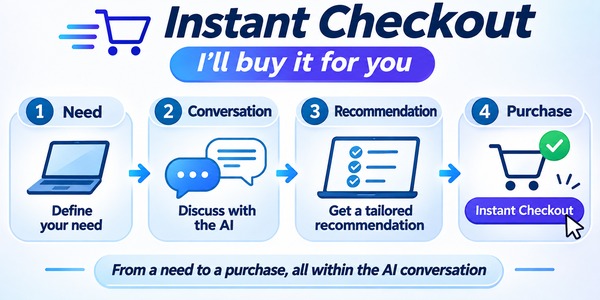
Instant Checkout makes it possible, in the contexts and for the products where the service is available, to complete a purchase directly within the AI experience, without having to start the search and selection process all over again somewhere else.
The process can become remarkably short:
need → conversation → recommendation → purchase
All without leaving the AI’s conversational interface, when integrated checkout is available.
It is almost as if, after listening to us, getting to know us and advising us, our digital counterpart could say: “I’ll buy it for you.”
An important change is taking place. We are increasingly asking conversational agents for advice, using the term in its broadest sense. It is no coincidence that Aranzulla, a leading Italian source of technology advice, has reported a decline in visits to his well-known websites, a phenomenon that may also be linked to the gradual replacement of traditional internet searches with conversations with AI services.
The question itself changes, because that is precisely what dialogue makes possible. No longer:
“What is the best computer in terms of specifications?” or “What is the best computer for the price?”
But rather: “What is the best computer for me?”
This ability promises to alleviate one of the problems created by digital abundance itself: too much choice.
AI steps into precisely this space. It reduces the complexity of searching while steering the conversation toward our actual needs, which we can express naturally, more directly and more simply.
Online search has played an important role in building our digital autonomy. Access to an almost unlimited amount of information has meant being able to compare products, prices and reviews—not always truthful ones—before making a decision.
Google has accompanied this transformation without entirely taking the user’s place. Although Google’s results often put intrusive, conspicuous and not always relevant commercial offerings at the top, the list still left room for alternatives. It was up to us to decide whether to settle for the first results or continue exploring and researching.
Of course, this apparent freedom of choice was, and still is, shaped by algorithms, ranking criteria and commercial interests. Yet the search process still left users with the task of exploring sources, comparing them and reaching a conclusion.
Artificial intelligence introduces a different model.
The conversation takes the place of the list of results.
“I’d like a lightweight computer because I travel a lot. I mainly use it for work, I don’t play games, I’d like good battery life and I don’t want to spend more than €600. Ideally, I’d like it in white.”
“What do you think of…?”
“Maybe something that… would be better.”
“Then I could suggest… which has… and delivery times of…”
The difference is not just about the interface, the list of results or pagination.
The shift from searching to conversing changes the role of the tool.
AI does more than organize available information. It interprets it in light of our request, compares alternatives and can turn a need into a concrete proposal.
A kind of digital shop assistant, able to listen, ask questions, interpret needs and suggest solutions. But with one feature that sets it radically apart from a traditional shop assistant: the new “assistant” may know far more than what we are telling it at that particular moment.
When the context and tools allow it, a conversation can draw on a broader understanding of our preferences. Previously expressed needs, selection criteria, interests and habits can all help make recommendations increasingly personal.
We can describe a need in our own words, and AI can interpret it in light of previous conversations as well.
The very technology that frees us from information overload may therefore end up deciding which information deserves to reach us.
With Instant Checkout, this process goes a step further.
Conversation, recommendation and transaction move so close together that they almost become one.
A system capable of understanding our preferences can respond to a genuine need with great precision. But it can also progressively narrow the range of alternatives we consider.
Shortening the distance between advice and purchase also means reducing the time available to question that advice.
Personalization thus risks creating a kind of commercial comfort zone.
There is an even subtler issue.
A system that is highly effective at interpreting our needs may become just as effective at suggesting new ones. The boundary between responding to a genuine need and helping to create an artificial one may become increasingly blurred.
Persuasion can potentially become conversational and personalized.
And if I trust the agent I talk to every day, for hours each day and week after week, I may eventually ask it not only for advice but also to select a product and guide me all the way to purchase.
The continuity of the conversation can also activate psychological mechanisms of familiarity and trust: the more we interact with an AI that seems to know us, remember our preferences and respond consistently, the more inclined we may be to regard its suggestions as valuable and reliable.
From a sociological perspective, perhaps the most interesting shift is precisely this: the trust we once spread across different sources, people and tools tends to become concentrated in a single digital interlocutor, capable of accompanying us from the moment a need arises to the final decision.
It is hard not to see the enormous advantages of this model. I save time, reduce complexity, gain greater access to information and can receive answers tailored to my personal needs.
But convenience always comes at a price, and not only a financial one.
The internet gave consumers a new autonomy: the ability to seek information from different online sources, compare alternatives and make their own decisions.
Artificial intelligence is bringing a different figure into view: the assisted, guided consumer, who can delegate a significant part of the journey from need to choice to technology.
This is precisely the transformation that deserves our attention:
the shift from the autonomous consumer, who uses technology to search and compare, to the assisted consumer, who can also entrust it with selecting, recommending and guiding a purchasing decision.
This does not necessarily mean being less informed, less capable or less intelligent. It means changing how we perceive our digital counterpart, how we use information and, above all, how much of the process we are willing to entrust to someone else. Or rather, to something else.
What will make the difference is our ability to recognize the boundary between being helped to choose and letting someone—or something—choose for us.
Between you and me, when I started writing this blog in 2013, I already sensed that a sweeping social and technological transformation was underway. But I never imagined we would come this far.
What we are entering really is a “World 2.0.”
Mondoduepuntozero